MATIAS OLIVIER DERMOND


CAPSTONE
THE TALKING DRUM PROJECT
Background
This project centers around Dr. Pierre Tchetgen, a CAMD professor who is researching new ways to facilitate literacy development in children, specifically through the use of a ‘talking (Djembe) drum’. The Djembe drum - a traditional instrument of West Africa - produces several distinct sounds depending on how and where the drum is hit.
Recognizing the potential to use this ‘multimodal communication’ to aid in literacy education, Dr. Tchetgen created an engaging developmental game wherein children interact with a modified, child-friendly Djembe. Specific drum strikes produce distinctive sounds while concurrently triggering electronic signals in a table game, manifesting as visual stimuli and letters. Despite the promising concept, Dr. Tchetgen currently uses a rudimentary prototype for his testing which lacks critical aspects of functionality, usability, and reliability.
To that end, our capstone team was tasked with the design and manufacturing of a ‘research-grade’ device suitable for repeated educational use with large groups of kids.


Images of the Djembe 'Talking' Drum in use


(Left): A kid playing with Dr. Tchetgen's initial prototype, (Right): Demonstration of how three different sounds on a Djembe drum would be produced

(Left): Table of Morse code-like translation from combinations of the three sounds to letters, (Right): An example of one of the chapters of the developmental game
A rendering of the Final Talking Drum Prototype
Design
Through collaboration with the client and considerations for how the Djembe drum is played, the team was able to come up with an ergonomic design for the drum body and strike zones. The motivation behind the wedge shaped body was to efficiently capture the area which a drummer actually strikes the drumhead. The plate shapes and sizes were designed to provide a more drum-like experience and the ability to play with both hands.


Bass
Slap
Tone

A labeled diagram of hardware used in the final prototype

Dr. Tchetgen testing our first functional prototype with visual and audio feedback
ANSYS Modal Analysis


Modal Analysis Data pulled from ANSYS for different plate thicknesses and material
ANSYS FEA Modal Analysis of Plates and iterations of Rubber Isolator designs
Reverse Engineering for Piezoelectric Signal Characterization


To better understand what the signal from a piezoelectric sensors looked like and how to measure 'crosstalk', we reverse engineered a commercially available professional drum pad. With our own prototype, we were able to conduct the same testing to collect and compare data.

Prototype with piezoelectric sensors hooked up to an oscilloscope
Results

Final Prototype Exploded view Animation

Prototype on drum stand

Silicone Molded Isolators in front of the FDM mold
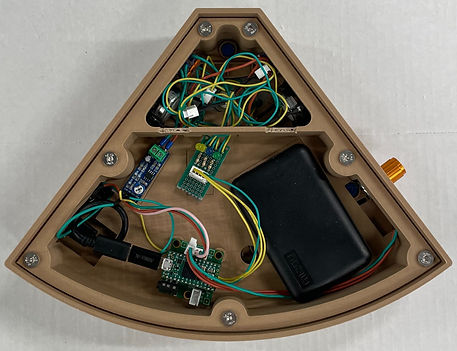
Final Stand alone prototype internal view

Final Stand alone prototype

Shoutout to the team and our fantastic advisor Prof. Andrew Gouldstone for wrapping up the semester as Track Winners!